
A Guide to Weighted Average Cost of Capital (WACC)
Reviewed by Neil AinsworthLast updated: February 16, 2026 2:29 pm

Image credit: RDNE Stock project @Pexels
In this article:
What is WACC?
WACC (weighted average cost of capital) is a core financial metric used to estimate the overall cost of funding a business with a mix of equity and debt. It approximates the average return that a company is expected to provide to all capital providers in order to finance its assets. Beyond theory, WACC informs decisions on investment appraisal, valuation and financial planning.
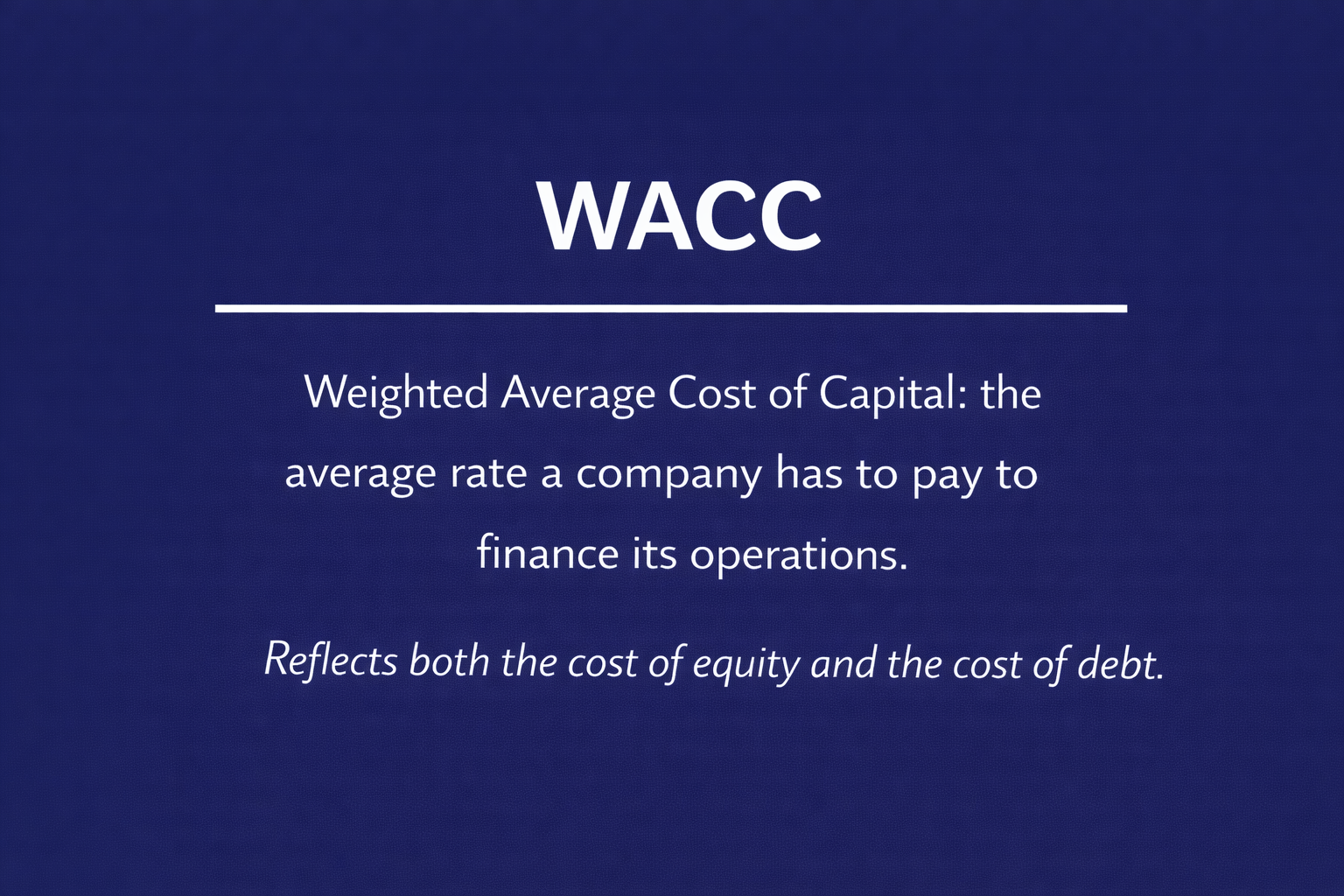
WACC can also indicate how a company’s capital structure and risk are perceived in markets. Because interest rates and market conditions change, the inputs to WACC can move materially, which in turn affects choices about project funding and capital structure.
WACC is often used as a benchmark when evaluating investment opportunities. Companies typically favour projects whose expected return exceeds their WACC, as this suggests value creation. A careful, up-to-date calculation helps avoid over- or under-investing. Using WACC as a hurdle rate assumes the project’s risk and capital structure are broadly comparable to the company’s; it is one input among many and not a guarantee of outcomes.
Understanding the Components of WACC
To calculate the WACC, firms consider several components:
- The market values of equity and debt, to determine the proportion each contributes to the overall capital structure.
- The cost of debt, influenced by prevailing interest rates, the firm’s credit quality and the terms of borrowing.
- The cost of equity, often estimated using models such as the Capital Asset Pricing Model (CAPM), which consider the risk-free rate, beta and the equity market risk premium. Other approaches (for example dividend growth or multi-factor models) may also be used where appropriate.
These components are combined in a formula that allows for the tax benefit of interest (the “tax shield”). This highlights how fiscal policy can influence corporate finance decisions.
Accurate WACC estimation requires current financial data and a clear view of market conditions. The result informs assessments of prospective returns and decisions about capital structure, risk management and long-term planning. A well-supported WACC estimate helps align financial strategy with operational goals and market dynamics.
How is WACC Calculated?
WACC combines the costs of equity and debt to reflect a firm’s overall cost of capital. A simplified, step-by-step approach is:
- Identify the Proportions of Equity and Debt: Determine the market value of the company’s debt and equity to understand their proportions in the total capital structure. Use current market data for accuracy.
- Calculate the Cost of Debt: This is the effective rate the company pays on its borrowings, often approximated by the yield to maturity on traded debt or the current margin on bank facilities. Because interest rates can change, monitor market conditions regularly.
- Calculate the Cost of Equity: The cost of equity can be estimated using models such as CAPM, which consider the risk-free rate, beta (systematic risk relative to the market) and the equity market risk premium. The risk-free rate and market risk premium vary over time.
- Apply the Formula: WACC = (E/V x Re) + [(D/V x Rd) x (1-Tc)], where:
- E = Market value of the firm’s equity
- D = Market value of the firm’s debt
- V = Total market value of the firm’s financing (Equity + Debt)
- Re = Cost of equity
- Rd = Cost of debt
- Tc = Corporate tax rate
This formula reflects the tax shield from interest. The corporate tax rate must be kept up to date and varies by jurisdiction. For UK companies in 2026, the main Corporation Tax1 rate is 25%, with a 19% small profits rate for profits up to £50,000 and marginal relief tapering up to £250,000.
Additional Considerations in WACC Calculation
When calculating WACC, also consider external factors and practicalities:
- Market Volatility: Volatile markets can affect both the cost of debt and the cost of equity. Update inputs such as beta and capital-structure weights regularly.
- Interest Rate Movements: As interest rates change, the cost of debt can shift quickly. It is advisable to keep abreast of central bank announcements and market pricing.
- Global Economic Indicators: Inflation, growth expectations and risk sentiment influence investor return requirements and the equity risk premium.
Incorporating these factors can make WACC estimates more robust and decision-relevant. Where project risk differs materially from the company’s average, consider using project-specific discount rates or complementary methods (e.g., adjusted present value).
Why WACC Matters
The Weighted Average Cost of Capital is more than just a number. It underpins several areas of corporate finance and investment analysis:
- Investment Decisions: WACC is often used as a hurdle or proxy discount rate against which expected returns on an investment are measured. If the expected return exceeds WACC, the investment may be considered potentially value-accretive, subject to other risk and strategic considerations.
- Valuation Models: In valuation methods such as Discounted Cash Flow (DCF) analysis, WACC is used as the discount rate to calculate the present value of future cash flows. Estimation accuracy matters, as it directly affects valuations.
- Performance Measurement: Comparing WACC with return on invested capital (ROIC) helps assess how efficiently a company is generating value. A ROIC that consistently exceeds WACC indicates effective capital allocation.
- Risk Assessment: Changes in WACC can signal shifts in a company’s risk profile, whether from market conditions or company-specific factors. An increasing WACC may indicate rising borrowing costs or higher equity risk premiums.
Understanding the nuances of WACC helps management, boards and investors make informed decisions aligned with business objectives and prevailing market conditions. Using WACC appropriately is particularly important when conditions are changing.
Application in Financial Strategy and Planning
Companies use WACC to help optimise capital structure by balancing debt and equity. The objective is to support a sustainable cost of capital and long-term value creation. Strategic decisions on new projects, mergers and acquisitions and other investments are typically assessed against WACC or a project-specific alternative. When interest rates or credit spreads move, maintaining an appropriate balance becomes more challenging and requires regular review.
Enhancing Corporate Policy and Strategy
WACC can also inform decisions on dividend policy, share buybacks and financial leverage. Keeping WACC assumptions aligned with market conditions and the company’s financial position supports transparent financial reporting and sound governance.
WACC is relevant to regulatory and reporting considerations. Ensure calculations and disclosures are consistent with applicable accounting standards, tax rules and internal governance.
Getting Advice and Further Learning
Given its complexity and importance to strategic decision-making, calculating and interpreting WACC carefully is essential. A qualified accountant or corporate finance professional can help assess financing options, estimate inputs, and explain how changes in markets or operations might affect the cost of capital and risk profile.
For individual investors, WACC is one of several tools used to analyse companies and does not, on its own, indicate whether to invest. If you need personalised recommendations, seek independent advice from an adviser authorised and regulated by the Financial Conduct Authority (FCA) and check the FCA Register.
This article provides general information only and is not investment, legal or tax advice. Capital is at risk and the tax treatment of returns depends on your circumstances and may change. If you are unsure about a course of action, consider obtaining regulated advice.
This article contains external links for further information on topics. Whilst all attempts are made to verify the trustworthiness of these external sources, we accept no responsibilty for the upkeep or security of these external websites. Some of these links in particular are annotated below:


